Updated on 26 June 2026 · by Pepe, painter in Elche
Combining colours is what holds most people back when it comes to painting: the fear it'll look busy or that the colours won't go together. I'm Pepe, a painter in Elche on the Costa Blanca, and I'll give you an easy formula that works nearly every time, without needing to be an interior designer.
The 60-30-10 rule
It's the trick I use most to not go wrong: you split the room's colours into three proportions.
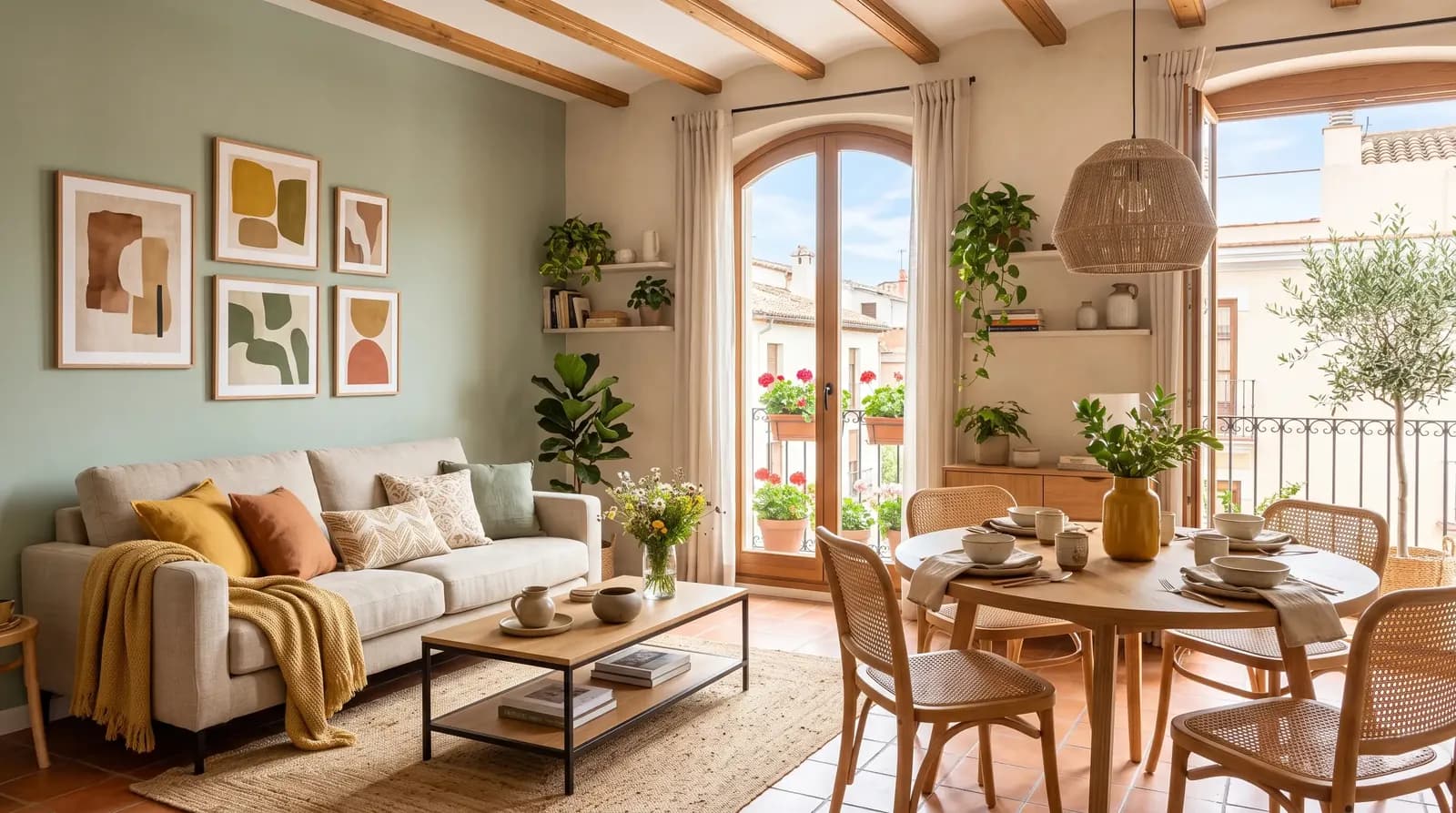
| Proportion | Where it goes | Example |
|---|---|---|
| 60% base colour | Main walls | A warm neutral (beige, off-white) |
| 30% secondary colour | Curtains, sofa, rug, one wall | A mid tone (sage green, blue) |
| 10% accent colour | Cushions, pictures, details | A brighter touch (terracotta, mustard) |
Choose the base first
The 60% is what dominates, so start there: a warm neutral (beige, sand, greige or off-white) is the safe bet because it goes with everything, opens up the space and adds light. On that base you can then play with the rest without the room looking busy. If in doubt, go neutral on the walls and put the colour in the accessories, which are easier to change.
The accent colour, used with sense
The 10% is what gives it character. It works really well concentrated on a single accent wall or in the soft furnishings. To pick it, look at what you already have (the floor, the furniture, a rug you love) and take the tone from there: that way everything talks to each other. Colours that are in fashion and combine easily: sage green, dusty blue, terracotta.
Mistakes that make it 'jar'
What spoils a combination most:
- Too many strong colours at once (more than one or two compete and tire the eye).
- Ignoring the floor and the doors: they're 'colour' too and have to go together.
- Mixing warm and cool tones with no logic (a warm beige with a very cold grey doesn't sit right).
- Forgetting the light: the same colour changes a lot depending on which way the room faces.
Want the exact price for your project?
I will come and see it with no obligation and give you a fixed quote, free and the same day. You deal directly with me, no middlemen.
FAQ
- How many colours can I put in one room?
- Two or three is enough and looks smart: a neutral base, a secondary and an accent. More than three strong colours tends to look busy and tire the eye.
- Will you help me choose the combination?
- Yes, it's part of the job. When I come round to give you the quote we look at the light, the floor and your furniture, and I'll steer you on base, accent and finish, no obligation. You decide.